The NOLA411 domain name is for sale. Buy nola411.com for your business. Perfect name for your news, entertainment, real estate, tourism, content. It is a perfect domain for the Travel and Destination Influencer!

NOLA411 for New Orleans News, Info, Events

Get the 411 on the 504. Information about what's happening in New Orleans.

Local New Orleans Weather

NEW ORLEANS WEATHER

NOLA411 is available

Own this great domain name. Perfect for Entertainment, News, Sports, Travel, Tours, Dining, Local Info, Events or Lodging in New Orleans.

Showing posts with label OffBeat Magazine. Show all posts

Saturday, September 12, 2020

Live Music Needs Your Help! - [OffBeat Magazine]


Sign the form to pass the Restart Act to save live music across the US.
This content is restricted to subscribers.

Subscribe!

The post Live Music Needs Your Help! appeared first on OffBeat Magazine.


Source: OffBeat Magazine


Buy the NOLA411.com domain name for your website!
Share:

Friday, August 28, 2020

KATRINA CHRONICLES: A FIRST-PERSON ACCOUNT - [OffBeat Magazine]


In preparing to post this month’s remembrances of Hurricane Katrina from local musicians and writers, I was looking for a good lead photo. I ran across Folsom, Louisiana artist Rolland Golden’s webpage and saw an image that sort of encapsulated the absolute horror that Katrina rained down on New Orleanians, my family, my friends.

Anyone who went through that time has stories, and I heard many of them, and had some to tell on my own. My critically ill mother was trapped with my sister and her family in Lacombe; we had no idea if she’d be able to make it through. To our great relief, my sister and her kids made it to Baton Rouge the evening after the storm hit (where my Joseph and I had evacuated), along with my mother. She was near death, and we immediately took her to the hospital where she stayed for six weeks, not knowing that her house had been flooded with 10 feet of water. It was horrible and heart-wrenching.

Yes, we all had stories to tell, but seeing Rolland Golden’s “Katrina Triptych” brought back memories of a chronicle of a Katrina experience I’d received from Lolet Boutté, the eldest of the musical, artistic Boutté clan. Lo is the eldest of 10 children, including vocalists John and Lillian, artist Peter, and mother to vocalist Tricia (Sista Teedy) Boutté. (All of the lovely Boutté sisters are memorialized in John Boutté’s song “Sisters”). Like all New Orleans families with deep roots, families are of ultimate importance. The matriarch Gloria Boutté, was beloved not only by her family, but throughout New Orleans.

I had no idea back in September 2005 that Lolet, her sister Nettie and their friends had endured the flood, enduring the heat, elements, lack of water and food on the I-10, or their final trip to Houston, where Lolet lived for several years before returning to a Musicians’ Village home in New Orleans.

I love Lolet, as do so many who know her; we were lucky enough to work with her at OffBeat for a few years in the ‘90s, and we’ve kept in touch over the years. She’s a very talented artist and now has her own successful art studio. She’s soulful, she’s smart, she’s beautiful, she’s talented, she’s outspoken and opinionated, and witty as hell. She’s a truth teller. She’s as feisty and gorgeous as ever, 15 years after Katrina, after everything she’s been through.

The following story chronicles what happened to Lolet, her sister Nettie, their friends, and id emblematic of what so many others went through after Katrina. It still brings tears to my eyes knowing that she and so many people had to suffer through this. It does the same now when I think of all the people who are suffering and dying from the pandemic and the economic hardships it’s created for the people in this country. What’s even worse is that we are not prepared to deal with utter catastrophe, not then and apparently not now, either.—Jan Ramsey

A PERSONAL JOURNEY OF THE EFFECTS OF A CATASTROPHE ON ONE LIFE

I OPEN WITH A LOVE LETTER TO YOU

I haven’t been writing much emotional stuff about my view of what happened to me because of Hurricane Katrina. God! I hope that the first female I meet named Katrina is not a 9-month-old baby. I have all intentions of slapping the shit out of the little bitch.

I’ve been living with the most phenomenal people. Without even questioning, they have allowed me to heal the way I know how—with peace and quiet. I showed up at the Longstreth’s house with two pair of pants, three shirts, two pair of shoes and, with  lots of what most females grab up, drawers. I have never felt poor or without since I crossed the state line into Texas. Longstreths and Texas, I can never repay you for your kindnesses.

Mahalia, Granny, Paul [Longstreth]’s 13-year-old German Shepherd, has helped me through my grief of losing Big O Dog, Kingston Dread. He was my backbone through the worst of Katrina. He was my buddy on Derbigny Street and made my Mama feel safe next dor. She told me that she could tell who was coming in the yeard by his bar. Thank you, Mahalia. I miss you Big O.

My sister, Lorna, has taken a heavy load off my soul. She’s taking care of our Mama. My child, Mama, my sisters and brothers, my nieces, my dear friends, may your Creator hold you in the Beatific Vision,  your prayers kept me and Nettie going I never thought for a minute I would die up there, I was praying that you would not look at the shit the mega-news media was showing on TV.

Nettie and I were there and I was listening to the small garbage on a small FM/mp3 player (lots of batteries). It wasn’t what we saw from our bedroom on I-10 West and Poydras. I knew they were scaring you to death.

Now I ask that you let me send the story to you in installments. I started at the end and will go no further tonight. As my spirit calms, I’ll write more. I can promise you that my story is not all sad. Some of it will be heartbreaking, but some of it will be funny, heart-warming, angry and opinionated. I reserve the right to tell the store from my view on what I felt, learned and made me so emotional when I was given the smallest of kindnesses.

It’s 10:25 p.m. in Houston, on Friday, September 30 [2005]. Thank you for letting me share this with you. Teedy [Lolet’s daughter vocalist Tricia Boutté] and I move into our own space tomorrow. With Love, Lolet.

KATRINA, KINGSTON AND ME

When did it start? The days have jumbled up together since the day before the catastrophe. It started for me Sunday August 28th. So I’ll begin there.

Sunday, August 28, 2005.
Kingston Dread a.k.a. Big Ole Dog. Photo: Lolet Boutté

All the bottles and containers are filled with water. I have plastic bags filled and flattened in the freezer to make ice for the cooler when Entergy breaks down. There are lots of canned and boxed food and enough dog food to last Kingston for over a week. When this blows over, I’ll get more and start cleaning up the mess tha this bitch is going to throw around. I have such a problem saying or writing the name, but here goes: “Katrina.”

  1. To answer your question: Why in the hell did you stay, Lolet?

I’ll give you my first and foremost reason only—Gloria Boutté [Lolet’s mother]. She wasn’t going anywhere and I wasn’t going to leave her. (Sorry, Mama, please don’t feel guilty; I’m a grown-up and take full responsibility for that decision). Second? Kingston.

Yeah, he’s a dog. So what? He was there at her side during some of the most trying times Tricia went through during chemo treatmants; he’s been my good buddy at times when I needed to say things without being judged or criticized, and he would never have left me. Enough?

Anyway, on Sunday afternoon [musician] Kim Longstreth and her crew were leaving for Houston and offered us a ride. Glo wasn’t going, remember? Half an hour later my brother Emanuel and his wife Denise came to the house and demanded that Mama leave with them. Their truck was filled and there was room for one. That’s OK. Peter [Boutté, Lolet’s brother] was coming over to ride it out at Mama’s house. We won’t be alone. When I called Pete to find out when he would be there, I found out that he had followed Manny to Bayou Lacombe. They were going to ride it out with my sister, Leda. I was more worried for them than me because St. Tammany Parish floods a lot.
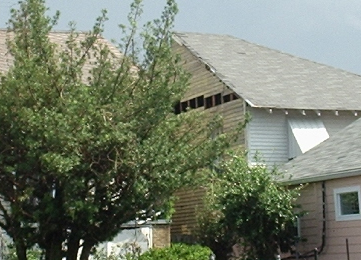
Peter’s Apartment. Photo: Lolet Boutté

I called my sister, Lynette. She wasn’t going anywhere out of concern for her salon business being damaged and looted if it came to that. OK, I’ll pack up some things and ride it out in Pete’s apartment that’s above the shop on North Prieur and Kerlerec Streets. It was me, Big Ole Dog, a few clothes, meds, my mp3/FM radio player, lots of batteries, my grandmother’s St. Anthony beads, and dog food. When this was over, we’d go back home and assess the damage. We were going to be fine.

That night was spent in front of the TV watching the track of the storm. When I could take it no more, I’d put in a DVD, pause it to check the weather, the go back to watching a movie. Nettie and I stayed in touch by phone. She was just across the street and had four houseguests living with her (BeBe and her three kids).

Late that evening the winds started to blow. Still watching TV and DVD and checking that all was secure in their apartment. We had a large bottle of Kentwood water and lots more downstairs if we ran out. The fridge was still working and had some eats that would be easy to fix, since the stove was gas. About one in the morning, the power went out.

Monday August 29, 2005

Just after midnight, I decided that I would just try to get some sleep until it was over. That lasted for about an hour.

The window at the northeast of the bedroom blew out and wind and rain started to blow in horizontally. I grabbed the two large cushions for the sofa, the portable radio and Kingston Dread. Pete has a tiny hall in the middle of his apartment and I braced one cushion against the door and one on the floor, put the St. Anthony beads around my neck, and sat against the door cushion to brace it against the wind. It was the most frightening thing I’ve ever experienced. The entire building was swaying, the wind was working to knock me away from the door and I was sitting there praying on the beads and holding onto Kingston like a lifeline. I’ll never be able to say how long I stayed in that hall. All the windows were covered and I didn’t even know if it was daylight outside.
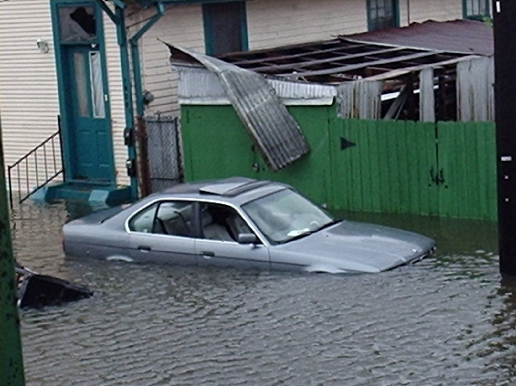
Room with a view. Photo: Lolet Boutté

I uncovered one of the windows and the sky was absolutely beautiful but I hadn’t looked down. I opened the front door to the apartment and my heart dropped. Water was up to the top steps of all the houses; the cars had water to the dashboards. I knew that Nettie’s shop and Mama’s house had water. I wasn’t sure about Nettie’s house but I just knew my place on Derbigny Street was OK. We lived in the Esplanade Ridge part of the Tremé and we were in one of the highest parts of the city. We made it through Betsy and stayed dry.

The phones were cut and the cell phone towers were blown away but it was quiet enough for Nettie and I to talk to each other over the roof of the salon. She didn’t have water in the house but it was about three inches from getting in. That made me feel better. I knew that my place around the corner would be OK too. For right now, I wasn’t going anywhere. I wasn’t mentally prepared to face walking in the water. Not yet.

Our neighborhood fix-it man, Morris, had been checking on us to see if we had all we needed. He came by with an armload of cigarettes and dog food for Kingston and Tai, Nettie’s dog. When I asked if he broke into someplace, he tells me he didn’t have to. This stuff was floating in the water and it’s all watertight. We welcome anything that will make life easier. I spend the day on the balcony of the apartment watching the folks go by and hearing snippets of news from those brave enough to be down there. All the while, I’ve got the radio on the combined stations of Clear Channel Radio (forgive me for disliking you so much, I considered you a death to small radio stations). Calls are coming in from all over Louisiana about folks stranded, people trying to help and being blocked from coming in. Never anything about help coming, just help being denied. It’s our only lifeline to the outside world and it’s not sounding good. Plaquemines, St. Bernard, the Lower 9, East New Orleans, the levees are not holding up. The 17th Street Canal has ruptured and Lake Pontchartrain is spilling into the city. I watch the water to see if it’s rising but it had already come in. Now we’re watching the tides right here in our own neighborhood. It goes down with the low tide and rises in the daytime. It’s not getting much higher so it must have leveled off.

I hear heartbreaking stories on the radio from people who are stranded and can get no help. The Feds are clueless bitches. I only hear the horrors of the Dome roof being torn off and thousands of people in the dark and panicking in the shelters and I feel secure on that upper balcony.

Big Ole hasn’t done his business in two days because he’s used to going outside. He can’t go down there in the water so he has shut himself down. It’s OK, you won’t be punished. We spend the rest of the day sitting outside and making as much human contact as possible. Nettie and Kim (BeBe) bring some more water and essentials to me. They go into the salon and get water. It’s completely flooded. NOBODY IS COMING TO NEW ORLEANS TO HELP!
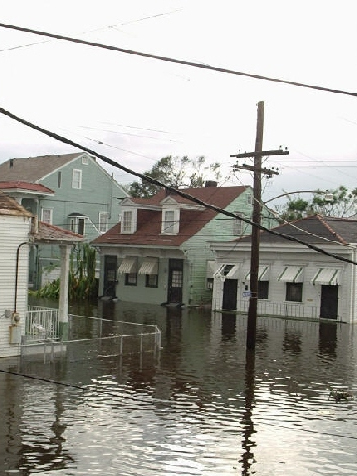
The sky is clear and the lake is in the city. Photo: Lolet Boutté

Tuesday, August 30, 2005
I slept on the porch last night with as little clothes as possible. It was so hot and damp inside the apartment that I couldn’t sleep in there. Pete has several large towels and I use them to drape the railing, use the two sofa cushions for a bed and keep the radio on constantly. The sky looks like someone pitched a fistful of stars into it. It’s beautiful—ironic, huh? The president of Kenner has seceded from the U.S. and declared the city of Kenner a foreign country so that they can get assistance. Go on, Nick. Dish the bitches out. Aaron Broussard is in a panic trying to get help for his people. A reported on the united radio stations cries that the Gulf of Mexico has reclaimed lower Plaquemines Parish. NOBODY IS COMING TO LOUISIANA TO HELP!

Wednesday, August 31, 2005
Today’s my only child’s birthday and I can’t even call her.

Nettie calls to me over the salon roof that we are going to try to get to the interstate to get rescued. John’s friend Gregory comes down Kerlerec Street to check on us. He is dry on North Rampart and has phone service. We ask him to contact our folks and let them know that we are OK and going to wade to I-10 to try to get out. I ask him to contact Tricia in Norway and let her know that I’m OK.

We make it around the corner to Derbigny Street to check the damage. It’s horrible. We get into Mama’s house first. The water is hip deep and her beautiful cedar chest that had been in the hall is floating in the middle of the living room. My knees get weak and I have to climb over corrugated paneling to get to my side door. I’m blinded by what I’ve seen at Mama’s and walk into my house where things are floating. I don’t see anything right, so I misjudge the height of the water. I walk to the chest of drawers, get my passport and some underwear. I walk into our second room, open a drawer next to the computer and grab as many of my records on discs that I can find and then leave. We collect several bottles of drinking water, large plastic bins and plastic bags.

When we get back to Prieur Street, we pack as much as we can in plastic bags. We’re going to use the containers as flotation devices to keep our things dry. I go back upstairs to get at least one bag packed and hug and kiss Kingston. Morris has promised to take care of both dogs until he can get the pets rescued. I feel secure in this because we told him he could have anything he wanted out of any of the houses. We have given him keys to Pete’s, Nettie’s, Mama’s and my house. He was also left with the promise by Nettie that he would die the same death as the dogs if they were treated inhumanely. (Thank you, Morris, you did a great job with Big Ole).

OK, we’re ready. We head toward Esplanade Avenue on North Prieur. I’m told to lift my feet high like I’m marching because there are tree limbs underwater. According to the radio reports that’s not the only things in the water. Those small bubbles in the water are cracks in the gas lines, there are oil slicks, sewage, garbage and dead things too.

As we make the corner on Esplanade, my heart breaks. The majestic oak trees are forming a cathedral arch over the neutral grounds. Huge pieces of them are beneath the water and we must meander or step over them until we get to Claiborne Avenue where there are boats abandoned at the gas stations. The water is waist deep. After we negotiated the obstacles in the water, we get on the exit ramp of I-10 East and head west toward Canal Street. Someone tells us not to look to the right because there’s a dead body there. We start our hike. I have my camera with me so that I might document some of the history on our walk. I take some pictures of the outskirts of the Tremé. The weather boards have been ripped off the sides and backs of the houses, the roofing tiles are gone and I can see the skeletons of several homes.
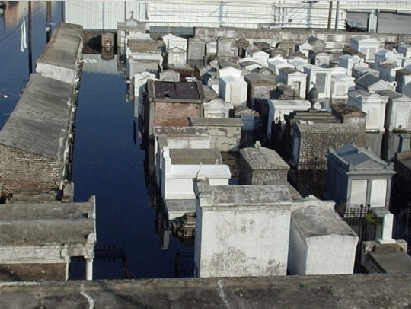
St. Louis Cemetery: Our ancestor are floating. Photo: Lolet Boutté

Oh, no! St. Louis Cemetery is flooded. My ancestors are floating in that swill. How will this city ever recover or go back to what it was? Do we really want it to be how it was?

We (Nettie, Kim, her 4, 10 and 14-year olds, and I) make it as far as Canal Street on the interstate. The fancy palms, the traffic signals and street signs are horizontal to the street. The hotels and businesses [have water] to the tops of their first floor doors. Air boats are speeding down Canal Street! We talk to some of the folks on the highway and they tell us nobody is coming for at least three days. We can’t stay up here with three kids that long! Nettie and I decide to wade back to the houses but we need to leave fast because when the sun sets, it will be too black to find our way back. We get there just before dark. Kingston is so excited to see us that he makes it down the steps and into the water. I help him back up the steps and do my best to dry him off. Back to square one.

That night I thought I heard the Mayor of New Orleans’ balls drop. He’s cussin’ and fussin’. He’s angry and feels helpless. It’s the first time I’ve considered him a man. [Governor] Kathleen [Blanco] has her fingers in her nose and ass. Dubbya has his whole hand up his ass. THEY’RE FIGHTING OVER WHO WILL HELP, WHILE PEOPLE AND BABIES ARE DYING!

Thursday, September 1, 2005
Nettie shouts over the roof that rescues are happening at Mac 42 [McDonogh 42 School] and we’ll be making the walk to the school soon. We start our trek again and have to avoid certain streets because the water is above our heads. We make it to 42 where there are several refugees waiting in the front entrance and on the steps of the school. After about an hour, someone comes by and says that the rescues have stopped for the school. Nobody’s coming to help. We’re on our own again. The Creator is good. One of the streets we bypassed had a mother with her dead baby tied to her chest and she would not leave her. We had babies with us and this would have been way too much for them.

Folks are coming to the school for help, but none is coming. A young man who had negotiated a boat came to the school and we decided that we would go to interstate when the older people and small children are placed in the boat and the rest of us will walk together behind it. Just as we’re leaving, I spot Martha and Mary, seventy-two year-old twin friends of the family. Martha has a pacemaker and Mary has renal failure. They are in flimsy nightgowns and are being helped to walk by Mary’s two children. I ask the boatman to wait and we load them into the boat. We will try to get to the Elysian Fields exit to I-10 East and head west away from the city. When we get to St. Bernard Avenue and North Galvez Street, the water is neck-deep on me, I’m high stepping because of the large trees down under the water. When we get to St. Bernard and North Prieur, they put me in the boat. Nettie is afraid I’ll go under.

When we finally reach the entrance to the interstate we have to leave Martha and Mary. They can’t make it up the ramp yet. It breaks my heart. I hug and kiss both of them and pray they will be safe. WHO THE FUCK IS RESCUING PEOPLE AROUND HERE?
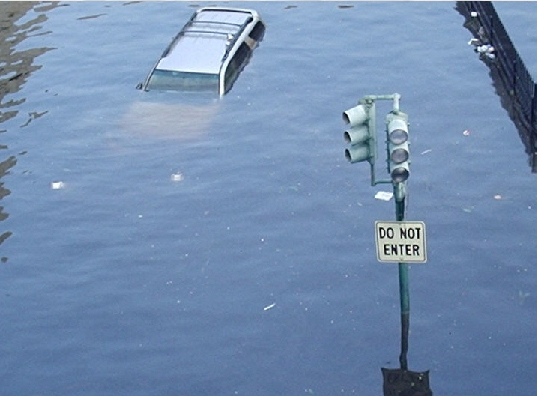
Canal Street and Poydras. Photo: Lolet Boutté

We make it back to the Canal Street spot on I-10 and get an offer from a young man in a truck to get us a little further down the highway. We take it and end up at Poydras Street. We hear, again, that nobody’s being picked up. Nettie and I decide that we’re going to park our asses here until something happens. Buses, military vehicles and trucks with boats are flying by in the middle lane. The other lanes are peopled with refugees— that’s right, refugees—I feel like I’m in a third world country. Some are sitting, some standing, some lying on the concrete and there are a few in wheelchairs. Seniors are looking stunned and kids are clueless and confused. Parents are constantly yelling to keep the children out of that middle lane. We’re in a place where it’s easy to cross over to the westbound side of the highway. This will be our living space until we are rescued.

The hurricane has ripped a good portion of the Dome’s roof. The people in there are suffering. Children are dying. There’s no water or food in there. Folks are losing it and they are being told that, if they leave, they won’t be allowed back in. Helicopters are flying overhead and dropping folks off like there’s actually room and safety in the building. I see a big chopper with “Air Force One” on the side with about four others escorting it to the heliport.

Wait! Oh no they’re not! They are pushing the people back into the Dome for “security” so Bush will be safe at the podium. THIS IS BULLSHIT! According to the radio reports, the air rescues are also halted so that the air space is secure as long as this asshole is in town.

Today I learn another lesson in prejudgment. It’s blazing hot and there’s no water or food being delivered to anyone camped on the interstate. Out of the corner of my eye, I see two young African Americans (male and female) eyeing a Kentwood water truck parked on the exit ramp. As I turn around, I see them driving off with the truck. Where the hell do they think they’re going? How long before someone stops them? How long before they are behind bars?

A little while later, I look to my left and see two Kentwood trucks coming up the wrong way on the Poydras ramp loaded down with water. The young man and woman open the sides and tell the folks on the highway to take what they need. They leave with two young folks riding shotgun and return with FOUR trucks loaded with water and start passing it out to the refugees. In a matter of time, the trucks have made it down to as far as they can go and distributed water to all the folks on the interstate. NEVER MIND, WE’LL SAVE OURSELVES.

Forgive me, young folks, I judged you harshly before knowing what was going on. (Another lesson learned).

Later that day, we get more folks in our area including some Danish and Swedish tourists who were stranded with us. Then we get the kids with their blunts and boomboxes. They have no clue where they are going or what they are going to face. So many awakenings sitting by waiting to be rude to them. Like everybody else, the shock will set in soon enough.

Do they really think the rescue crews will allow pit bulls on the buses?
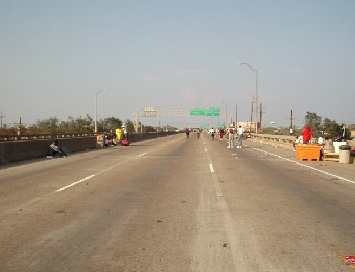
Interstate-10. The long walk to Canal Street. Photo: Lolet Boutté

It’s still light when we get some new folks in our immediate area. They are friends of my sisters and have a beautiful African American woman suffering from skin cancer. She’s been out in this heat for two days without shade and evacuated so fast that she wasn’t able to get her meds or sunscreen (they were washed away in Lower 9 rushing waters). A covering is built for her with blankets and two grocery carts. She’s at least safe from the sun for now.

We pass the time becoming familiar with our kindred refugees. Whole families are up on this huge piece of concrete. Most of us are hot, dirty and have an air of restrained distress. We chat and reminisce the way New Orleans folks do on their front steps and porches. The resourcefulness of the human spirit.

Occasionally, I cross the concrete barriers of the interstate and talk to a nice lady who has been in the water with foot surgery. Her sons have been fighting and she seems bewildered. She welcomes a little talk about other things besides her kids. There are several small kids with her entourage and they are ravenous. They are eating up everything brought with them and rations passed out earlier. One look at them and I can see they’ve never suffered miss-meal cramps.

The sun is going down and only a very mild wind gives us some relief. Looting, burning and madness are going down in the water, in the shops, in the neighborhoods. Chaos is growing and it’s all being reported on the radio before anything is verified. TURN OFF THE TVS AND RADIOS, NOW!

Wait, I’m listening to a series of events on the radio that seem out of sequence:

First: “HazMat vehicles are lined up on the outskirts of the French Quarters.” (At this time, there are large flashes of blue, red and yellow. Next, I feel the tremor on the highway).

Second: “The French Quarter is ablaze!” (From where I sit, those blasts didn’t happen in the Quarters. They look like a fireworks show on the river behind the roof of the Dome).

Third: “It’s not in the Quarters. It’s on the outskirts on the other side of Elysian Fields. We don’t know what caused the explosion but have been told it was three tank cars on the train tracks in the Bywater!”

First HazMat, second explosion, third French Quarter? Check the sequence….and then comes the smell drifting toward us from the Mississippi.

THEY TRIED TO BLOW US AWAY.
NOW, THEY’RE TRYING TO GAS US!!!!

I turn the radio off. I can’t stand much more.
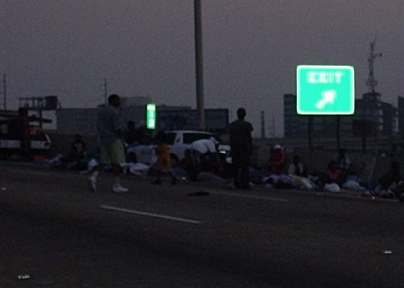
Our “apartment” in the utter darkness on I-10 with other refugees. Photo: Lolet Boutté

It’s getting dark and, as much as one wants to think some normalcy is happening in the daylight, it gets very dark. There are no lights except for emergency vehicles, noisy air patrol by the helicopters and some news crews parked on the interstate. It’s creepy dark.

No sleeping for this princess. The gravel in the concrete is so big it makes it tough to just sit, let alone sleep on it. I sit up the night and pray that we lose no one up here tonight and that my family finds rest from their worry.

All night, large buses are passing us going toward the ninth ward but not returning or coming back with no people on them. What are they doing? Is anybody being saved? The phone calls on the radio are frantic pleas from the Convention Center where there is no supervision, food, water—nothing. People standing in their own waste, mothers have gone outside where they feel safe but their babies are dying in their arms. There’s rape, murder and suicide in the building. We’ve descended into madness.

Radio notice:

“The Louisiana oil refineries have requested that its workers return to their jobs and bring changes of clothes since they will be on-site until further notice.” Yeah, right. The refineries take priority over the workers’ families.

Friday, September 2, 2005

Day breaks and the strangest things are happening. Our I-10 families are wishing each other a good morning, there are grills up here fixing breakfast and coffee. Folks are washing up with the precious water. Mamas are combing and braiding hair. LADIES AND GENTLEMEN, THE SURVIVORS.

The rest of the afternoon is no more eventful than the others except now there are military convoys with soldiers bracing very frightening guns on their shoulders. Would they shoot us? In a heartbeat. Between the guardsmen are the regulars—buses, trucks with flatboats, emergency vehicles and empty buses (not many of those). The radio tells us that the buses can’t come for us because there are not enough military or police escorts to insure the safety of the drivers. Some try to make it across the Crescent City Connection on foot and are turned back. Seems that inhumane treatment has extended to the locals. Jefferson Parish and [then-sheriff] Harry Lee are on the other side sending people back. They will not be allowed on THEIR dry land. THE CREATOR IS WATCHING YOU GOOD OLE BOYS.

At about 3 p.m. some vehicles start showing up and not flying past us. We are parked close to the Crescent City Connection blockade. It seems to be the right spot since we were among the first groups picked up. There are ambulances taking women and children first. (Too many families lost one another with this method.) Three families get into the third ambulance and we are among these folks. The drivers are all volunteers from Florida who just couldn’t sit by and watch the suffering any more. They take us a small distance from the Dome where we are packed three to a seat and back to belly, standing on Orleans Parish school buses. Each of us is allowed one piece of baggage (on your lap, please). I’ll carry the damn thing on my head. I’m getting out of here!

The excitement dies down when I come to the realization that we do have idiots among us. These young folks will wake up to some new rules that apply outside the Crescent City. Someone jokes about body functions and how bad these culprits are for farting on a packed bus. IDIOTS!!! You’ll never forget that smell and will welcome a fart next time. THOSE ARE BODIES IN WATER FOR FIVE DAYS! May the Creator rest their souls.

We are riding toward Armstrong International [Airport]. Somewhere along the way, we turn off and park along a very dark road. Large tour buses are idling on the shoulder. We are being moved to board for the last leg of this nightmare. Our first kindness is shown by a Louisiana state trooper who allows us to get on a second bus and away from the young thugs from the school bus. The luxury of the air conditioned bus escapes me. I’m freezing after being in the heat for five days. No complaints, there’s leg room, the bags are in the storage compartment, children are sleeping.

Nettie and I settle into the front seat opposite the driver. We ain’t crazy, this man’s making his third run between New Orleans and Texas and we are not about to kiss our asses goodbye in a bus after we showed our asses to Bitch Katrina. We hold pleasant conversation with the driver and find out that we are being brought to Dallas. Our tensions ease a little bit but we won’t rest easy until we speak to the Boutté family. We need to know that everybody is OK, let them know we’re OK and that we love them all very much.

There’s still no sleep for me. I want to be up for sunrise on dry ground. I want to see the sign “Welcome to Texas.” As we ride up to the Texas Visitors Center, I can’t believe my eyes. There are large tables spread out all over the grounds, tables with breakfast foods (hot and cold), a medical tent with doctors and nurses to visit, toys for the children, volunteers serving us like we are special guests. I’m speechless and can only say “thank you.”

We return to the buses for our final destination. Our spirits are lifting a little and we just want to get there. When we reach the Dallas Convention Center there is one more procedure to go through before being allowed into the shelter. Body and bus search must be made for the safety of all survivors/refugees. Those refusing are moved aside and not allowed back on the bus. THANK YOU TEXAS.

Once allowed into the Center, we were processed by the Red Cross, given identification bands and offered free phones, mobile phone charges, bathrooms, sleeping space, and food, food, food. Breakfast wasn’t picked up until lunch was ready. Lunch wasn’t picked up until dinner was ready. Constant arrivals always had food and comfort no matter what time they arrived. A play area was set up for the little ones and hosted by the Dallas cheerleaders. A play area was set up for the bigger ones and hosted by the Dallas Cowboys. THANK YOU TEXAS.

We immediately joined the long line for the phones. Nettie makes the first call and is able to learn that [daughter][ Tanya is OK. After that, she was completely worthless. I have never, never seen my sister cry so hard that she couldn’t breathe. Tanya, your mama loves you very much. She is able to let them know that we were safe and in Dallas. Tanya had made it to Houston and was safe with some dear friends, the Guillets.

I was able to get in touch with Paul [Longstreth]. I knew he and his sister made it to Houston and they would have heard from Tricia. He told me to look for him in three hours. He was coming to get me! I would have refuge with the Longstreths. Tricia is due in from Norway the next week. I’ll be able to hold my baby in my arms.

I won’t tell you what I found in my clothes from three days in them after walking through the water. I will tell you that I started crying and couldn’t stop. Not from weariness, not from hunger, not from fear, not from the sadness that would grip me after my rescue to Houston. I was crying because I felt I was being treated like a human being for the first time since August 29. The smallest kindnesses overwhelmed me. THANK YOU TEXAS.

Paul was there in three hours and we turned around and immediately went back to Houston. I told him that I wanted to take a shower, a bath and another shower. I was welcomed into the Houston Longstreths’ home and made at ease as I have mentioned in my love letter to you.

Texas has been very kind to thousands of New Orleans’ native children and still shows this giving nature to us as I write this. You won’t see much of that side of the story on the news. They are good at showing the bad stuff. It’s what “news” is made of, sadly. Whether this will be our permanent home, whether we will come back home or move someplace else, I have learned that being a survivor means home is deep inside the bones. It has nothing to do with “place” on this earth. My roots go deep, deep in to the silt and wet soil of New Orleans. Our family has a recorded history that leaves its mark all over the city. These roots are not just musical. The creative spirit appears in whatever we choose to do with our lives. We can document twelve, do you hear me, twelve generations in New Orleans. Our family is scattered across the country and it makes no difference. The Boutté ties are so great that we will survive. We will love each other as strongly as we did when we were all in the same house. GRIEVE, NEW ORLEANS, YOU’VE LOST A GREAT COLLECTIVE TREASURE.

I grieve for families lost, I grieve for neighborhoods vanished, I grieve for loved ones displaced, I grieve for the bodies still waiting to be found, I grieve for those washed out to sea and who are not being counted, I grieve for those souls who will have no saints marching them into heaven. MAY THE CREATOR REST YOUR SOUL, NEW ORLEANS. I WAIT FOR YOUR RESURRECTION.

As I complete my story, Yolanda Adams sings “While riding through the storm (I ride safely in my Savior’s arms)…”

—Lolet Boutté, January 3, 2006

About the Author:

Lolet Boutté

Lolet Boutté is the first born of ten artistic, gifted siblings that cover every spectrum of creativity including visual artists, vocal artists, filmmakers, photographers, TV producers and top-notch financial experts and advisors. Her parents were avid readers and encouraged reading to the children at a young age. At three years old, Lolet was allowed to draw in their large Book Club collection, “as long it was in the blank spaces and not on the words.” This strong base of encouragement and school awards in the arts resulted in Lolet graduating from Xavier University of New Orleans with a B.A. in Fine Arts. Her first successful sale was made at her Senior Exhibit just before graduating. The piece was titled “Guitar Player,” a block print on stained rice paper, purchased by a N.Y. State Representative who was the commencement speaker. Boutté’s craftsmanship, under the early tutelage of her grandmother, resulted in her working as a graphic artist with several government contract companies at NASA Louisiana for 17+ years. As “side inspiration,” she kept her creative juices flowing by doing commissions, costume designs, inspired whimsy and teaching traditional Mardi Gras Indian beading. Lolet put her art on hold after the flood in New Orleans had destroyed almost all of her original works but, with the encouragement of living in the Elder Street Artist Lofts in Houston and being surrounded by wonderful people, she “collected” her inspiration and returned home to New Orleans to live among another group of inspiring young and senior artists and musicians. No “style” can be attached to her works because she studied “Liberal Arts” and believes that’s the green light to be liberal in her individual pieces. She has a deep love for pen & ink, gets into personal mythology if she uses an airbrush, always feels a challenge when using colors and may be working on a piece of tree, an old roof shingle or beading a mysterious face. Her website and her Instagram page showcase her works.

The post KATRINA CHRONICLES: A FIRST-PERSON ACCOUNT appeared first on OffBeat Magazine.


Source: OffBeat Magazine


Buy the NOLA411.com domain name for your website!
Share:

Friday, August 07, 2020

Austin leads the way to policies for reopening music venues - [OffBeat Magazine]


The “Reopen Every Venue Safely” (REVS) project is a nationwide effort, led by Music Cities Together, that’s being participated in by eight cities around the US, including Austin, Cleveland, Seattle, Portland, Louisville, New Orleans and more.

Each city has committed to working on policies that will encourage all music venues to open safely, with criteria developed specifically for each city, by participants in each city. Almost every city has a clear connection to government representative(s); New Orleans, unfortunately, does not. There is still no one in New Orleans on the city level who is working specifically with music venues to help them in designing policies that will keep the venue businesses, musicians and guests safe, so that our reputation as a “Music City” can once more be resumed when we move forward into Phase 3 and 4.

Representatives in New Orleans are still working on a plan while bars and venues are still closed to the public. Austin has recognized for years how important live music, music venues and music events are to its economy (the annual South By Southwest event was cancelled this year for the first time in its history; its impact on Austin’s economy is estimated to be $355.9 million annually).

Because Austin’s city government is involved in its music economy, it appears that Austin is the first to come forward with a specific plan and recommendations to gets its famed music clubs open and running again (Austin is currently in Phase 4 of its COVID-19 prevention strategy; New Orleans is still in Phase 2). We present it here, and hope New Orleans can make a plan as thorough as this; if nothing else, this could be used as a model for our policy in a strategy to reopen New Orleans music venues, festivals and more. What we do not have, however, is a clear connection to who at the city level will and could implement recommendations such as the one Austin presents in this report. That’s something New Orleans has needed for the past two decades. If we’re going to call ourselves a music city, we have to work with the venues who present our live music to the world.

The post Austin leads the way to policies for reopening music venues appeared first on OffBeat Magazine.


Source: OffBeat Magazine


Buy the NOLA411.com domain name for your website!
Share:

Wednesday, July 15, 2020

Not To Be A Debbie Downer, But… - [OffBeat Magazine]


It’s been a while since I wrote a Mojo Mouth. I was hopeful and waiting for this virus thang to slack off, and was thinking by now, we would have seen the numbers going down and gertting back to “normal.”

Alas: not to be. In fact, it’s much worse than before because just recently I now have family members who are either sick or who are quarantined because they’ve been directly exposed to those with the virus (just happened within the past couple of weeks).

So, here we are again. We’re all running out of unemployment, PPP funds, and to be more basic about it, rent and food money.

Not to be a “Debbie Downer”—you know the Saturday Night Live character who was always pointing out negatives when everyone else was trying to be positive—but I am worried.

As you’ve probably noticed, OffBeat is no longer being distributed as a print publication in metro New Orleans. There aren’t too many people on the street to pick up any free print pubs, and there aren’t many restaurants or other retailers who are open and thriving. Bars have just been ordered closed. Live music is kaput. There’s very little advertising out there, and we’ve been around this long because our advertisers support what we do. But: our supporters are hurting, and we know it. We’re keeping afloat the only way we can: digitally, cutting our overhead, and bringing in a few dollars from our shop.

It was just announced that K-Paul’s, Paul Prudhomme’s signature restaurant on Conti Street, was closing permanently. This place was delightful, and I can remember talking to Paul one evening as he sat outside the place about food and music as integral parts of the city’s culture. Sadly, Chef Prudhomme passed away suddenly in late 2015. Now his namesake restaurant will also be laid to rest. Owners say it just can’t sustain “bleeding” money any more.

One must always be upbeat and hopeful in the light of such a devastating blow as the coronavirus. Yes, we’ve been through Katrina, and New Orleans bounced back, and we can do it again. But this catastrophe isn’t just affecting New Orleanians: it’s statewide, countrywide, worldwide. We’re all in the same boat, but in my mind the workers who are going to suffer a lot are musicians, bands and anyone who works in the live music field.

We all recognize that New Orleans’ stock-in-trade is food and music. Yes—at least for right now—you can still get some great food here, but to a much lesser extent than we could prior to the lockdown. But restaurants can’t operate at full capacity; locals are either afraid to go out (or don’t have the money to eat out as much as they used to). There’s a fraction of the visitors compared to those who used to come to New Orleans, even in the summer. New Orleans cannot possibly sustain the number of restaurants it used to have pre-Covid now. What’s even worse is that it’s going to take a long time before tourists come back in the numbers they used to. If you don’t think that New Orleans restaurants need tourism dollars to survive, well, you’re just wrong. But at least restaurants are able to make a little bit of money doing take-out. But how many of them can survive a long-term shutdown (now in its fourth month with no clear end in sight) and be in a financial position to wait for a resurgence of tourism? For that matter, how many hotels and hospitality industry-related businesses can either?

It’s worse for bars. They’ve been shut down almost totally in the last round of coronavirus lockdown. I always wondered how bars were going to reasonably require patrons to wear masks, especially after they had a drink or two. Not gonna happen.

But the worst off by far are the venues who present music and live performances. Right now, and for the foreseeable future, live music, theater, and festivals are done, over. Live music can’t be presented inside, or outside. I had a young musician tell me this morningthat he and other bands were dying to play—and I don’t think it’s just for the paycheck. When you’re an artist you need to play or perform. It’s part of your being.

So every single venue owner or festival producer I know (and I know a lot of them) are in limbo. Will they ever be able to re-open or present another live festival? Well, of course, that day is coming, but who among them can last that long. These are usually not businesses that have a huge bank account that can withstand months of having to pay rent, utilities, taxes and staff with no money coming in.

And of course, there are the musicians. When the lockdown first started in mid-March, many bands and musicians started performing via livestream. Those livestreams were going great guns for a bit, and it was putting some much-needed revenue into the pockets of musicians. But that’s kind of ended. The money’s not coming in like it was a few months ago.

So what are musicians who depend on live performances going to do? Will they be able to survive by playing music?

There are a few innovative ideas, like the C3/Voodoo Fest drive-in concerts at UNO’s parking lot. They been charging over $100 per car. But if you can only have maybe 150 cars at a concert, that equates to about $15,000. This isn’t enough to compensate a band or to aderquately pay everyone it takes to produce and promote a concert.

Are we going to be reduced to drive-in concerts, livestreaming and “virtual” festivals? It appears so, and it could continue for months to come. I was told by a local large promoter that no shows were in the works for them for at least another nine months to a year. I haven’t included the Saints, or Mardi Gras, or New Orleans’ other communal events.

And this isn’t just in New Orleans.

This is a whole new, strange world for anyone involved in live events, tourism, restaurants and music. It’s new and fraught with challenges we’ve never faced before. Will we be able to adjust to a completely different way of life…at least for the next six months to a year? Can we do it? Or will may businesses and individuals lose the battle?

The post Not To Be A Debbie Downer, But… appeared first on OffBeat Magazine.


Source: OffBeat Magazine


Buy the NOLA411.com domain name for your website!
Share:

Thursday, June 25, 2020

_WESTGUARD MEMBERSHIP TEST - [OffBeat Magazine]


Curabitur imperdiet id urna non gravida. Fusce posuere vulputate nibh, sit amet finibus justo volutpat eu. Cras dolor nisl, molestie ut blandit volutpat, posuere at sem. Donec non dictum tellus. Pellentesque habitant morbi tristique senectus et netus et malesuada fames ac turpis egestas. Etiam laoreet ante ut nisi facilisis finibus. Etiam id metus sollicitudin, dictum tellus ut, gravida nunc. Integer volutpat tempus nisl, eu bibendum libero bibendum eu. Curabitur hendrerit urna in nulla malesuada pretium. Maecenas sagittis nisl at faucibus venenatis. Quisque auctor leo a dolor interdum, et faucibus leo accumsan. Sed sed justo vestibulum, accumsan dolor a, condimentum nibh. Duis dignissim euismod est, in congue leo posuere ac. Sed ut dictum turpis. Interdum et malesuada fames ac ante ipsum primis in faucibus.
This post is only available to members.

The post _WESTGUARD MEMBERSHIP TEST appeared first on OffBeat Magazine.


Source: OffBeat Magazine


Buy the NOLA411.com domain name for your website!
Share:

Wednesday, May 06, 2020

What Will Be The New Normal? - [OffBeat Magazine]


What will be the new normal for listening to live music? What restrictions will we have so that we’ll be able to go out to listen to music at a music club or bar? Or go to a festival?

While COVID-19 confirmed cases and deaths continue to rise, some states and cities are slowly yielding to pressure from the federal, state and local governments (and some citizens as well) to “re-open” the economy. Now, it’s one thing to have the ability to go to a restaurant to pick up a take out order, or to a retail store to pick up something you’ve ordered online, or to a grocery store. It’s another thing entirely to consider the immense problems that opening up bars, festivals and music venues will entail.

Will we have to socially distance? Wear masks (good luck chugging a beer or drinking a cocktail with a mask on)? Our mayor has recently required that businesses be able to contact trace everyone who enters their doors. How will music venues, bars and festivals be able do handle this? What about the bands? Should members stand six feet away from each other? If music venues can only accommodate half of their capacity, will they be able to even pay a band if there’s not enough bar revenue or cover charges? How about the bartenders, sound techs, waitstaff? Will they be able to make ends meet on tips if there’s only 50 percent of customers allowed in the bar? These are complicated, thorny questions.

What would you be willing to do to be able to go out to listen to live music again at a music venue or a festival?

Let us know…we’re passing on the information to venue owners and the city. Take our poll and let us hear from you, the music lover and consumer.


The post What Will Be The New Normal? appeared first on OffBeat Magazine.


Source: OffBeat Magazine


Buy the NOLA411.com domain name for your website!
Share:

Thursday, April 02, 2020

Music and COVID-19 - [OffBeat Magazine]


Just like everyone else, I check the latest grim statistics daily; I listen to the latest news to see if any progress has been made in the fight against COVID-19.

Everyone from OffBeat is now working from home. Frenchmen Street is not only closed down, much of it is boarded up.  But daily, I call my family to make sure they are feeling okay. Every day I email and talk to friends and clients on the phone or on FaceTime. I meet with colleagues on Zoom to share news, have business meetings…and just say hello.

If you are well, we’re grateful.

We’re all in a very strange, unanticipated world right now. It’s even harder because most of us (if we’re at all cognizant) realize that things will never be the same as they were. And we live with a cloud of dread, not knowing who will or can survive this devastation physically, emotionally and financially. Just today, I heard several members of the Zulu organization had died as a result of the virus. A nurse who worked at a hospital in New Orleans East died from coronavirus complications; she claimed the hospital was not testing its  staff for the virus…until she developed symptoms. This is incredibly horrific to hear.

But here’s the thing that really brought the horror of this pandemic home. As I was writing this evening (Wednesday), I got word that Ellis Marsalis had died while he was being treated in the hospital with COVID-19 symptoms. This made it real

I had spoken with Bethany Bultman today (of the New Orleans Musicians Clinic and Assistance Foundation) and she gave me some even more frightening information. Many people in the music and cultural communities are older than 60. Some have conditions that make them more susceptible to the virus: a history of smoking cigarettes or marijuana; alcohol or substance abuse, Hep C, AIDS, and in general not taking good care of themselves—not because they don’t want to—but because they haven’t had the resources to do so. No health insurance, perhaps (you need it especially when you work as a musician); there are too many “occupational hazards” you have to deal with. Too little money to buy nutritious foods. Let’s face it: our musicians, culture bearers, artists and gig economy workers are, for the most part, probably living in less than ideally healthy circumstances. They, and the very nature of New Orleans’ culture, is in danger. I applaud the NOMCAF for stepping up to take good care of our music community in the past, and especially now. Their website has great resources for musicians.

Emotionally, I think that we all are currently caught somewhere in the classic Kübler-Ross model of the grieving process for our pre-pandemic lives: shock and denial, anger, bargaining, depression and acceptance. But some models add two more steps: reconstruction and hope. It’s difficult to be hopeful when the situation hasn’t quite yet bottomed out, when we are still in the process of seeing friends and loved ones sick and dying.

The same emotions hold true for New Orleans’ music community.

Many of us in music here are still in the shock and denial phase. How can we survive this? Even before the pandemic gathered steam, there were rumblings that our music scene was changing forevermore. Now it’s hitting home. Ellis. Wow.

I want to encourage everyone to do their due diligence in being extremely careful to follow “social distancing” and other government guidelines during this time. I wish some of our federal officials had taken this virus a lot more seriously long ago (I’d encourage you to watch this video, shot in South Korea, to see why that country is in better shape than the US; it’s long but very informative).

Please stay safe! Wash your hands diligently, stay inside as much as possible, and be careful. It’s the only way we’re going to get back to a semblance of anything “normal.” We’ll get through this. We have to.

The post Music and COVID-19 appeared first on OffBeat Magazine.


Source: OffBeat Magazine


Buy the NOLA411.com domain name for your website!
Share:

Thursday, March 26, 2020

WHY IS MEMPHIS DOING THIS, AND NOT NEW ORLEANS? - [OffBeat Magazine]


What a great idea! On the morning of March 25, I got this press release from Memphis:

Memphis Tourism’s Music Hub Launches “Get Live! Memphis” Online Music Festival with Facebook
Free Virtual Entertainment & Fundraising Event to Support Memphis Musicians During Global Health Crisis

In an effort to support Memphis’ local music community and engage global audiences, Memphis Tourism’s Music Hub has created a virtual music relay festival. The event will kick off with one performance on Thursday, March 26th, 2020 and continue through Saturday evening with performances scheduled at a variety of times over three days. The festival will be held via a Facebook event, co-hosted by Memphis Tourism and I Love Memphis. Several other pop-up virtual performances will happen throughout the week on Instagram Live to virtually promote the event.

“This is the time to give back to the Memphis music community that has given so much to our city’s cultural identity,” says Music Specialist Jayne Ellen White. “Our music has brought such joy to so many and now is the time to speak to the world through our universal language: music.”

The lineup includes headliners such as Mononeon, Ben Nichols of Lucero, and Grammy-nominated band Southern Avenue and eight other bands.

“Memphis Tourism’s Music Hub is partnering with Music Export Memphis to collect donations for a COVID-19 Relief Fund benefiting musicians who have lost gigs as a result of the health crisis.

“Memphians, especially our musicians, have always given back in times of need. This project serves as a way for the global community of music fans to help support the Memphis music community during this challenging time.

“’Our local musicians play an integral part of the Memphis destination’s identity as a live music city,’ says Kevin Kane, President and CEO of Memphis Tourism. ‘Their talents not only keep Memphis’ music scene vibrant but, now more than ever, they are able to share those talents to lift up, not only our local community but also a world of music fans. As people around the world connect with us during this virtual musical festival, these outstanding artists will have an opportunity to not only share their talents with new audiences, but also share messages of hope.’”

The event page, which is co-hosted by Memphis Tourism and I Love Memphis, can be accessed via this link.

I sent this press release to a representative at NewOrleans.com (New Orleans’ Convention and Visitors Bureau) and was told that they were working with restaurants remaining open to drum up business, working to rebook groups and festivals, and that if someone comes up with something they will help promote on social media. I also sent the same press release to the City of New Orleans Cultural Economy office, and have not yet received a response. It appears as though, once again, if the musicians and music ecosystem in this town need help, they have to put it all together themselves. It’s sort of always been that way, but you’d think that since that tourism studies show that New Orleans’ prime draws are food and music, that music would get some consideration in proactive efforts from city officials. Why isn’t this happening?

It’s going to be a long time until we can get back to anything near normalcy. Until then the music community needs help too, and the city should step up with all available resources to keep our music scene alive.


The post WHY IS MEMPHIS DOING THIS, AND NOT NEW ORLEANS? appeared first on OffBeat Magazine.


Source: OffBeat Magazine


Buy the NOLA411.com domain name for your website!
Share:

Saturday, March 21, 2020

Battered, But Not Out - [OffBeat Magazine]


From last week to this week, everyone’s world has changed drastically.

The entire state of Louisiana—indeed, the whole of the US—is on lockdown. We’re being battered healthwise, financially, economically, culturally by a non-sentient virus.

The entire music ecosystem—musicians, bands, bars, clubs, restaurants, doormen, sound techs, bartenders, servers, festivals (BUKU moved to Labor Day weekend; French Quarter Fest moved to October 1 – 4; Jazz Fest postponed until “fall”; Festival International canceled, and a lot more)—is affected.  Gatherings of over ten people are prohibited.

We’re in a situation none of us has ever experienced before.

The amount of economic harm the COVID-19 pandemic is wreaking is obviously that of people potentially getting sick, some dying. That’s really bad. But in New Orleans, the closing down of the entire city is having an enormously negative and unpredictable effect on our music scene and the city’s future existence.

We thought Katrina was bad. At least we could leave the city or state to go someplace where we could live safely and make a bit of money to pay the bills. This is far, far worse, and we’re all pretty much on the same life raft, wondering how in the hell we’re going to weather this storm.

Our April print edition was supposed to go to press this evening. But last Friday—before the mandatory closure of all live music venues, bars and restaurants—we got in touch with our advertiser/supporters, and the cancelations started pouring in. If your club or bar isn’t open, then there really isn’t anything to advertise. Musicians lose paychecks (and/or tips). The economic ripple effect in this community, which lives on tourists, is going to be deep, wide and long-lasting, depending on how bad the virus gets.

Obviously, we’ve had to postpone publishing the April print edition of OffBeat. We (our staff and contributors) and our clients are at the mercy of an unseen enemy that’s threatened to get stronger and more virulent in the next few weeks, or even months. Our commitment to our advertisers, our staff and to the music community is strong; we will publish in print as soon as we are able and when our clients and supporters are open and operating.

Assuming OffBeat does survive, the April issue has been completely written, with much more of it put on hold until French Quarter Fest in October.  We are endeavoring to get the next issue to the printer and on the streets by April 20; we will reflect it as the April/May issue. Going forward, we may have to continue with a June/July issue and then an August/September print issue. Right now, we are in limbo, and hope you understand our situation and will be patient. Hopefully, this crisis will pass sooner rather than later, and you’ll see an October French Quarter Fest guide in OffBeat, with the Jazz Fest Bible being printed and distributed concurrent with the fall Jazz Fest.

In the meantime, we will continue publishing news and features on OffBeat.com, on our social media platforms and via the Weekly Beat. If you have not subscribed to the Weekly Beat, we encourage you to do so at OffBeat.com. We’ll try to keep you posted any changes we know about (for example, a few clubs are starting to livestream performances).

For the foreseeable future, OffBeat will be published in a digital format only. Our small business, like many, many others, is not receiving the necessary revenue we need to keep printing, distributing or mailing the print magazine to our subscribers, or even to keep our office doors open. For the time being, the OffBeat staff is working from home, and doing our best to keep you and our extended worldwide music community informed.

We are looking at this crisis as an opportunity to extend OffBeat’s digital outreach to the 55,000 subscribers to the Weekly Beat and the hundreds of thousands of web readers and social media patrons who are loyal to OffBeat’s message about local music and culture.

If you need help getting the word out about any events, or the status of your band’s music or your business operations, please let me know.

Bonne chance to us all, and we’ll talk again.


The post Battered, But Not Out appeared first on OffBeat Magazine.


Source: OffBeat Magazine


Buy the NOLA411.com domain name for your website!
Share:

Thursday, March 05, 2020

Killing The Goose - [OffBeat Magazine]


As I climbed into my office chair overlooking Frenchmen Street, right before we closed the office for the Mardi Gras holiday, I was taken aback by the view of two guys—obviously not from around here—dancing/tweaking in the middle of the street to music blaring from a boombox at the intersection of Frenchmen and Decatur.

I expected that these guys are trying to get tips from passers-by. That was fairly obvious from the big white tip bucket they put beside the boombox. But little do they know that Frenchmen, despite its reputation as “Baby Bourbon,” doesn’t get the daytime tourist foot traffic tourists that Bourbon does. They left, and showed up later that evening at the intersection of Frenhmen and Chartres (more tourists down there by the brass band, apparently).

The OffBeat office has been on Frenchmen Street for almost 24 years. We moved here before Frenchmen was a “thing.” Back then it still had a bakery, galleries, a print shop, a doctor’s office, a small grocery store, and a few bars and restaurants. It was still like a lot of small commercial streets in the city. Everything but the bars and restaurants are now gone, and there are a lot more than there used to be. Not long ago, the beloved Praline Connection on the corner of Frenchmen and Chartres was bought by real-estate mogul Aaron Motwani, with lip service that the Praline Connection wasn’t closing, just “relocating” to another location on Decatur Street (yeah, for about 15 minutes). In its place, instead of great soul food and homemade pralines, we have the Frenchmen Street Willie’s Chicken Shack and Daiquiris, one of the many others owned by Mr. Motwani on Bourbon and in the Quarter.

I’m using Motwani as an example, but this is what happens when a street that has wonderful vibe and was a destination for locals to hear great music becomes a victim to rampant capitalism that runs out local patrons (other than maybe college kids—same thing happened on Bourbon) and concentrates on tourists, many of whom don’t give a damn about local music and musicians. Music is “music” to them, whether it’s a trad jazz band playing at Bamboula’s or a cover band blaring as loud as possible from Vaso. Zoning on the street prohibits restaurants from collecting a cover for live entertainment, which means musicians will never be able to make a decent wage at establishments like these, unless there’s an owner who is sensitive to the needs of the musicians. Yes, most of the venues on Frenchmen are restaurants (another zoning issue).

I suppose you could contend that this is the nature of businesses wanting to make money. Yes, I get it, and I understand. If these places didn’t exist, musicians wouldn’t have places to perform at all. But there’s a time when the city should step in and change things to guarantee that the very culture that created a cultural destination for both locals and visitors could become a place where musicians could at least expect a door cover charge for their efforts, and some kind of guarantee. Musicians still make the same amount of money they made 24 years ago. That’s a crime in a city that’s known for its music.

What happens when you don’t charge a cover—even a nominal cover, or something to signify that the entertainment and music is valuable—local music and musicians are taken even more for granted. And what’s even worse is that Frenchmen Street becomes less about the music and its quality, and more and more a party street, where music is just the background for drinking and debauchery. The same exact thing happened on Bourbon Street.

It’s getting more and more difficult for the music providing venues on Frenchmen to actually charge a cover to pay band because most of the venues on the street do not charge a cover. And let’s face it, freebie is more attractive than a $5.00 cover charge. The venues that do continue to charge a cover are having a more and more difficult time paying the musicians because the patrons of Frenchmen Street are expecting free music. And when it’s free, it’s valued less. It’s disposable, and has less value. That’s just a fact of human nature.

It’s going to get potentially worse. The people who owned the original venues on Frenchmen were, for the most part, interested in the music and culture when OffBeat moved its office to Frenchmen Street. That’s changing drastically as owners age out, get annoyed at the “scene” (which is becoming louder, less interested in music and more raucous), and sell their properties to others who don’t care enough about music and culture.

Other “entertainment” streets will emerge, St. Claude Avenue being the one most likely, but unless the city commits to managing, preserving and enhancing the night-time economy, and educating the public on the value and history of our music, nothing will change. I’m rather kind of sick of hearing that old New Orleans adage “Plus ça change, plus c’est la même chose” (The more things change, the more they stay the same) or “New Orleans’ incompetence is part of its charm.” Get a grip!

It’s only a matter of time until we have not one, but two full-fledged entertainment streets, targeted towards sucking as much money as possible from tourists, while devaluing one of our most important cultural resources. I hold the city of New Orleans responsible for the demise of our musical culture and slowly killing the goose that laid the golden egg. It doesn’t have to be this way. We have a cultural “fund” that can be used to manage and preserve our musical resources and economy. The city should use it wisely.
Currently, the $3.9-million that the current administration has received from the tourism industry is going to be distributed the rough a “Cultural Economy Funding Program,” set up to give “to individuals and organizations that are engaging in activities that promote the cultural economy through educating our youth, training our cultural producers, providing networking opportunities, creating cultural events and much more.” While this is admirable, this effort should also include funding for a person who will advocate and represent the cultural community, such as “night mayor.” It was just announced that Toronto, Canada has appointed someone in this position. New Orleans is missing the boat (once again) by deeming music and culture as “arts.” It’s more than that, a lot more. If we can’t appreciate that a well-funded and operational manager who can oversee business problems and  and cultural programming is integral to our economy, music and culture will always stay in the background as an adjunct to bring tourists here.

The post Killing The Goose appeared first on OffBeat Magazine.


Source: OffBeat Magazine


Buy the NOLA411.com domain name for your website!
Share:

Thursday, January 30, 2020

How Important Are The Grammys? - [OffBeat Magazine]


How relevant are the Grammys to a musician or band’s emergence as a legitimate star?

Pretty important, I’d say: even to be nominated is a special honor.

I’d be interested in seeing the overall effect for any Louisiana band that’s 1) been nominated, or 2) has actually won a Grammy. If they don’t make pop music, then it’s probably not a huge deal.

The Grammys—if you’re in the music business—evolved (and have been hyped) as the ultimate prize and doorway to one’s future as a musical star with everything that comes with that: fame, money, luxury, fawning appreciation, prestige.

Personally, I’m kind of over watching the actual Grammy Awards because I don’t live in the world of commercially-successful pop music. Fun to watch and listen to occasionally, but in another world entirely from the one I live in.

We’ve all known for a long time that New Orleans and Louisiana is “outsider” music. New Orleans and Louisiana musicians, for the most part,  just don’t live in pop-world. I suspect that they never will.

But that’s okay, I think. Music lovers who flock to New Orleans are not expecting, nor do they want to experience pop music (I’m not talking about folks who don’t really care about the music, its quality and emotional content: they experience music as a background for the party). People flock to New Orleans music because of its authenticity, honesty, its heart and soul, and depth of musical roots and traditions. I’d venture to say that pop music in New Orleans may be anathema to people who visit us to experience music. In fact, should the Jazz Fest go back to presenting all local musicians instead of including the rock and pop and their producing partners AEG present at the Jazz Fest, you’d probably have a more satisfying musical experience, but you sure wouldn’t be able to draw the crowds that the Fest needs to stay financially viable.

Pop sells, jazz doesn’t.

Country-pop sells, zydeco and Cajun don’t.

Hip hop sells, funk doesn’t.

We live in commercial world. And New Orleans just isn’t in that groove.

What do the Grammys mean for local musicians and music businesses here? Probably not that much, but it’s certainly lovely to be recognized, and an honor to aspire to. I kept waiting to hear more about Tank and the Bangas in the vast amount of publicity that I heard prior to this year’s event—they were nominated for Best New Artist Grammys this year. Didn’t hear anything on a national level. I’m thrilled that they were recognized with a nomination, but not so happy that Billie Eilish swept the Grammys. She’s talented…but is riding on a wave of hype. But that’s the way it is. Should New Orleans really try to surf that wave too?

The bulk of the Grammy Awards aren’t even given at the much-hyped awards show. They are awarded at a smaller event that the public doesn’t see. The Grammys are, if nothing else, about the exposure and cash generated by the awards show. Winning a Grammy gives you instant cred in the national music industry.

For anyone who’s been keeping track of the recent Grammys drama (recently-hired CEO Deborah Dugan was ousted after only five months after she alleged irregularities and favoritism in the voting process), it appears that the Grammy Awards could be more of an insider’s game: you win if you have the support of bigwig music industry people (who also include a wide raft of publicists who are paid to create hype and interest in an artist) who have inside access to Grammy voting.

Is that ever going to be the case for an artist from Louisiana? Do we need more high-powered music industry publicists, managers and labels here to make Louisiana music “Grammy-worthy”? Or even more radically: do we want New Orleans to turn into another Los Angeles or Nashville, with music success built on shallow (though lucrative) popularity and publicity?

Me, I don’t believe that’s what we really want. Is it all about monetary success or is it about being creative and loving what you do as an artist? Is it about jumping on the pop wagon to achieve Grammy star success or is it about making a decent living making good music that might not appeal to a least- common-denominator audience?

New Orleans has tried for years to create a music industry infrastructure (that’s how I started), but do we want to strive for Grammy success or merely a living breathing, healthy climate for all of our musicians? The latter goal certainly isn’t as glamorous as the first, but it’s worthy nevertheless.

I want your feedback on this…send me an email!

The post How Important Are The Grammys? appeared first on OffBeat Magazine.


Source: OffBeat Magazine


Buy the NOLA411.com domain name for your website!

Share:

Thursday, January 16, 2020

Folk Alliance Conference may be as powerful as Jazz Fest in helping musicians’ careers. - [OffBeat Magazine]


Many a musician has acquired a much larger new audience by being selected to perform at the New Orleans Jazz & Heritage Festival.

By gigging at the Fest, thousands of musicians have been heard by festival promoters, talent bookers, management company representatives, record labels, publicity people and club owners from literally around the world—to say nothing of the hundreds of thousands of Fest-goers who perhaps never had the opportunity to see or hear some of our great local music. It can truthfully be said that the Jazz Fest has been responsible for many a band’s career in music. (An aside: The Jazz Fest 2020 schedule will be available tomorrow at an undisclosed time; we’ll post it as soon as they give it to OffBeat).

The same holds true for the musicians who are lucky enough to have been selected to play at the Folk Alliance International (FAI) Convention.

I was pretty familiar with FAI through my old friend Louis Jay Meyers. Meyers was a smart, cool cookie, musician and concert promoter, and one of the co-founders of South By Southwest in Austin. He left SXSW in 1994, selling his share of the business, came to New Orleans and attempted to start a similar event in New Orleans: LMNOP (Louisiana Music, New Orleans Proud). It lasted three years. Meyers then went on to head up the Folk Alliance, back then based in Memphis. Sadly, Meyers passed away suddenly of a heart attack in early 2016; a great loss for FAI and for music folk, in general.

Another friend, Reid Wick, who’s now with the Recording Academy, attended a Folk Alliance Convention, and came back raving to me about how fantastic and different it was. That was probably 10 to 12 years ago (forgive me, Reid, if I don’t have the timing right), and right away the idea was hatched to ask FAI to have the event in New Orleans. Lucky for all of us music freaks, Wick is now on the board of FAI, and persuaded the powers-that-be (now headquarterd in Kansas City) to have the conference in New Orleans this year.

I can’t recommend this event enough to anyone who is involved in music in New Orleans. There are multiple showcases of Louisiana-based or –borne musicians, mentoring sessions, workshops, networking with music biz professionals (including festival and talent bookers from all over) and so much more. It’s sort of what “South By” used to be in its earlier years: less tech and corporate, more musician-centric, smaller and more manageable, and very user-friendly. Keynote speakers are Rhiannon Giddens (see a conversation with her in our January issue) and Mavis Staples. How can you beat that?

I’m so happy that OffBeat is part of this event (we are co-sponsoring Louisiana showcases with WWOZ on January 22 and 25). I wish I could go to every event on every day including all the showcases. There are multiple showcases throughout the event, but what’s even more interesting is that there are small, private showcases that take place in hotel rooms at the Sheraton. So you can go from showcase to showcase to hear fabulous musicians you may not have been familiar with.

Take our poll, and you may get a chance to win a pair of passes to FAI New Orleans. You really have to take every chance you can to make it there. It’s that good.

The post Folk Alliance Conference may be as powerful as Jazz Fest in helping musicians’ careers. appeared first on OffBeat Magazine.


Source: OffBeat Magazine


Buy the NOLA411.com domain name for your website!
Share:

Tuesday, November 26, 2019

Why Don’t We Appreciate Local Music, And Why We Should - [OffBeat Magazine]


GUEST COLUMNIST:  Shain Shapiro.

Shain Shapiro is a principal in Sound Diplomacy, a firm whose mission is to help create, support and sustain places to live for, rather than just places to live. Its strategic practice defined the “music cities model,” which uses music and culture in a deliberate and intentional way to deliver economic, social and cultural growth in cities and places. Sound Diplomacy was hired by GNO, Inc. to perform a study on New Orleans, which should be released in early 2020.

We take for granted what we use every day. Take clean water. For those lucky enough, we turn on the tap, and water comes out. Not only do we not realize that the simple act of turning on the tap is a privilege, but also by doing so we ignore the complex infrastructure that led to water coming out. From wells to filtration, desalination to distribution, dredging to waste management, an intricate system must function so we can take a drink.

When something is wedded into the fabric of everyday life, we ignore the systems that create, sustain and support it. The same cognitive dissonance is occurring with music and culture. When you hear a song that moves you, it’s about that moment with that song, not the recording, production and marketing functions that led to that moment happening. But without these systems and practices, those moments disappear; that tap runs dry. Music, like any other resource, is not infinite. If we do not teach, invest and support it, it disappears. Given music is our universal language – we all speak it – it must be better understood for its capabilities to support, sustain and improve communities around the world. This is happening in cities all over the world. It’s the merging of planning, resource management, resilience and intentionality around music, called music urbanism.

As an industry, music grew by 9.7% last year, fueled by the rise in streaming. Goldman Sachs research argues it will more than double by 2030, to more than $131 billion by 2030. It is omnipresent in our cities, towns and places, wherever we live. From baby namings to bar mitzvahs, communions to quinceaneras, even the adhan call to prayer, music is everywhere. Over the past decade, a growing number of cities are recognizing that in order to maximize the economic, social and cultural value of music, it must be considered in land use, regeneration, tourism, education and economic-development policies. This emerging field has created a new moniker – music cities – for places that think about music in policy, rather than simply enjoy it in practice. And those cities are creating this new music urbanism.

Thinking about music in this manner – as a deliberate and intentional policy – is new. Traditionally, cities have tended to interact with music in two primary capacities: through licensing sound and noise and creating musical experiences, including festivals, community events and tourist opportunities.

But, in both cases, this historical focus is narrow. There is no direct link to the holistic value of music on communities. This is what music urbanism addresses. Companies – such as Amazon in their HQ2 competition – frequently refer to a place’s quality of life as a core consideration. Along with breweries, outdoor space and walkability, music is a core urban indicator. A nation’s music education system is a wealth generator, such as Sweden’s. Musical participation increases access and promotes health benefits; it creates jobs and supports a wide number of sectors, from food and beverage to retail. Music in public transit can calm commuters’ nerves. These outcomes are wider than regulation and tourism. Viewed as a whole – as a music urban ecosystem – strategizzing its input and output can increase value, improve communities and drive investment.

Music in the built environment

Examined across a lifespan, music is an ecosystem that can improve all our lives. Exposing infants, toddlers and children to music has many benefits. Music in school demands cognitive, organizational and management skills; children in bands and choirs must work well with others, and showing up is a prerequisite. Research has shown that attending a concert every few weeks can add years to one’s life, while listening to music when we’re old can ease dementia and loneliness.

In our built environment, as we live in denser communities, better building codes, materials and streetscaping creates places for interaction, congregation and spontaneity. Festivals in and of themselves are pop-up urban places; supporting them can provide permanent facilities for the communities around them, as in the case of Nyege Nyege in Uganda. Music can be a tool to engage communities to tackle issues of prejudice, discrimination and unrest. In Madison, Wisconsin, a music and equity task force has widened a needed conversation about institutional racism. But these initiatives are siloed and approach music as a solution to a particular problem; not as a core strategic element in developing, fostering and maintaining community cohesion and economic growth.

This is what is slowly changing around the world as music urbanism takes shape.

Source: Sound Diplomacy

What are cities and places doing?

Many cities, regions and towns are in the process of developing music strategies. The best examples are those focusing on music as a holistic, community benefit, across economic development, tourism and inclusive growth. In France, the state is setting up a Center for National Music, tasked with researching the impact of music on each region. One of the most active, the Loire, collects economic data on the value of its music sector. In the United States, aside from Nashville and Austin (who have longstanding music policies), two dozen cities are leading the practice of music urbanism. New Orleans launched its NOME initiative, aimed at increasing the value of intellectual property for the city’s musicians. In Indianapolis, Indiana, the city’s strategy is focused on elevating local musicians, fostering tourism and increasing inbound investment.

In New York, an initiative geared to supporting female musicians was launched this spring. London has altered its planning law, to better support and prioritize cultural infrastructure, combating music-venue closures. Melbourne, Sydney, Brisbane and Adelaide have music policies, with the first operating a music office within the city council. Chengdu has an expansive growth strategy, including creating a new music district and 14 new concert halls. Many metropolises around the world have partnered with UNESCO to be music cities, which work to elevate the role of music in local governance. There’s a separate Music Cities Network as well, focused on information-sharing and best practice.

The University of Colorado at Denver, Visible College in Memphis and Monash University in Australia offer music cities courses, and the first academic book dedicated to music cities and music urbanism, Andrea Baker’s The Great Music City, was published this year.

Overtures for the future

Much of this work is dedicated to growing cities’ music industries, rather than exploring the role of music on local civic society as a whole. Most networks of music cities are either informal or prioritize information-sharing, rather than analyzing detailed land-use policy and appointing agents of change in forums, commissions and community groups. Moreover, certain genres of music are more supported than others. There are robust policies in place through arts councils and cultural outfits to support classical music, but little support exists, for example, for emerging MCs. In the UK, one subgenre of hip-hop, has been all but criminalized in a country where youth clubs, community recording studios and mental health support have been decimated by austerity.

This is music urbanism’s task: creating competitive advantage for cities who wish to engage. Music is the most personal artform we have. It is cross-generational and transcendent of culture, creed and race. But like water, music is not a renewable resource. It is dependent on land use, resource allocation and community engagement policies to flourish and be impactful. And this is a new way to explore the role of music, one outside of the commercial sector, as the goal here is better cities, along with more music consumers and thriving artists.

If we do not treat music consciously in urban policy so all cities have music officers, policies and processes, we lose out.

The post Why Don’t We Appreciate Local Music, And Why We Should appeared first on OffBeat Magazine.


Source: OffBeat Magazine


Buy the NOLA411.com domain name for your website!
Share:

Previous Posts